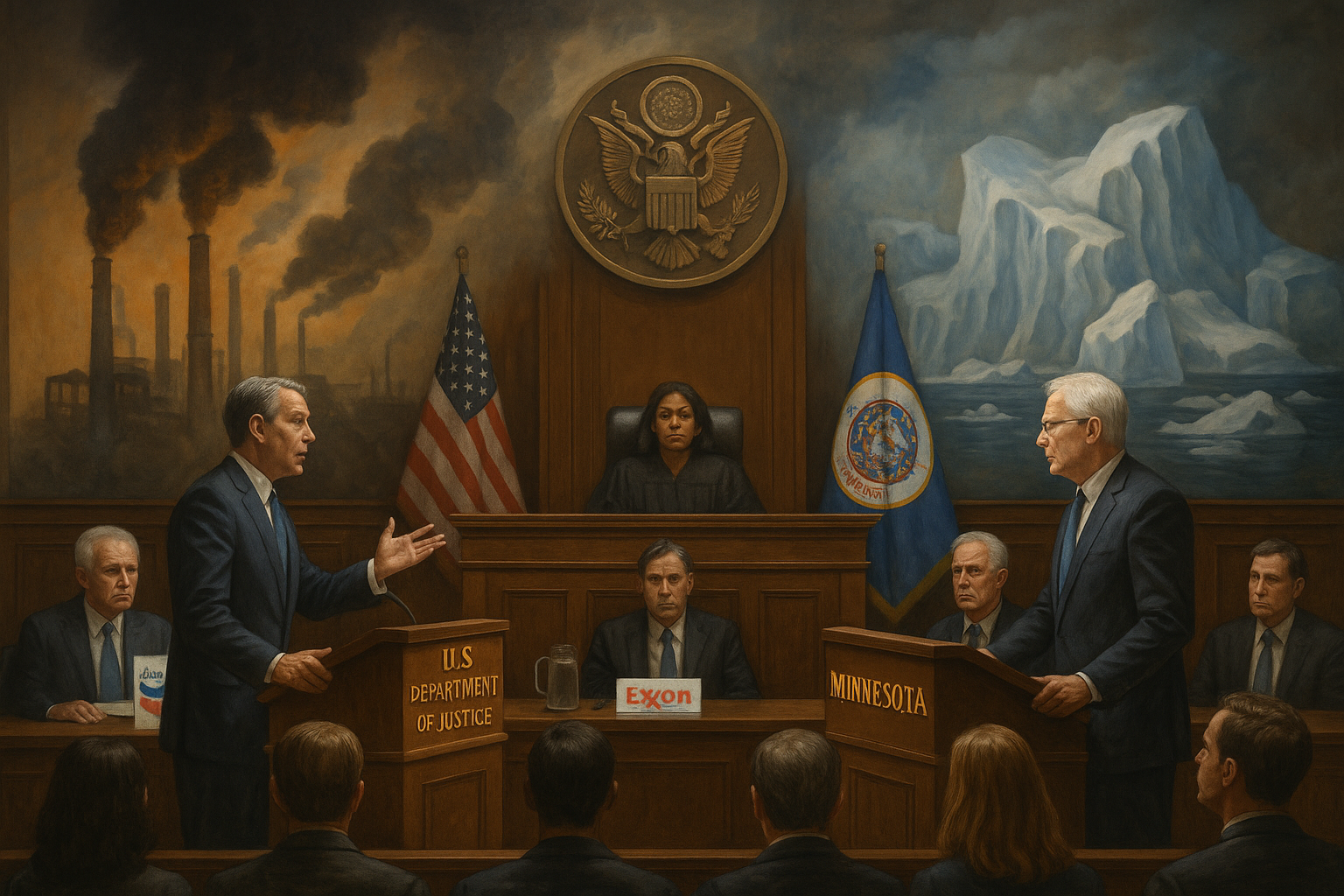
The US Department of Justice has filed a lawsuit against Minnesota, aiming to halt the state’s legal action against major energy companies over climate change impacts.
Key Facts
- The US Department of Justice (DOJ) has sued Minnesota to block its climate lawsuit against energy companies.
- Minnesota’s original lawsuit targets major oil and gas firms, alleging misleading the public about climate change.
- The DOJ argues that Minnesota’s case interferes with federal authority over energy policy and interstate commerce.
- The federal government’s action is part of a broader trend of legal challenges to state-led climate litigation.
- The case raises questions about the balance of state and federal powers in addressing climate change.
- The lawsuit has drawn national attention and debate over accountability for climate impacts.
- Energy companies named in Minnesota’s suit include some of the world’s largest oil producers.
- The outcome could influence similar lawsuits by other states.
Overview
The US federal government has taken the unusual step of suing the state of Minnesota to prevent it from pursuing a climate change lawsuit against major energy companies. The Department of Justice filed the suit, arguing that Minnesota’s legal action threatens to disrupt federal authority over national energy policy.
Minnesota’s original lawsuit, filed in state court, accuses several oil and gas giants of deceiving the public about the risks of fossil fuels and their role in driving climate change. The state seeks damages and penalties, claiming the companies’ actions have harmed residents and the environment.
The DOJ’s intervention marks a significant escalation in the ongoing legal battles over climate accountability. Federal officials contend that allowing Minnesota’s case to proceed would create a patchwork of state regulations, undermining the federal government’s ability to manage energy policy and interstate commerce.
This legal clash highlights the growing tension between state-led efforts to hold energy companies accountable for climate impacts and the federal government’s role in regulating the industry. The outcome of this case could set a precedent for similar lawsuits in other states, shaping the future of climate litigation in the US.
In Depth
The Department of Justice’s lawsuit against Minnesota is rooted in the argument that climate change and energy regulation are matters of national, not state, concern. By seeking to block Minnesota’s case, the DOJ asserts that only the federal government has the authority to regulate interstate energy markets and address climate policy at a national scale. This position is based on the Constitution’s Commerce Clause, which gives Congress the power to regulate commerce among the states.
Minnesota’s lawsuit, filed in 2020, targets several of the world’s largest oil and gas companies, including ExxonMobil, Koch Industries, and the American Petroleum Institute. The state alleges these entities engaged in decades-long campaigns to mislead consumers and policymakers about the environmental dangers of fossil fuels. Minnesota claims that this misinformation contributed to increased greenhouse gas emissions, environmental damage, and public health risks.
The DOJ’s legal filing contends that if states like Minnesota are allowed to pursue such lawsuits, it could result in conflicting regulations and legal standards across the country. The federal government argues that this would hinder the development of a coherent national energy policy and could disrupt the flow of energy resources between states. The DOJ also suggests that Minnesota’s claims are preempted by federal law, including statutes governing environmental protection and energy production.
Legal experts note that the case raises complex questions about federalism and the respective powers of state and federal governments. While states have traditionally played a key role in environmental regulation, the federal government has increasingly asserted its authority in areas with national implications, such as climate change. The outcome of this lawsuit could clarify the extent to which states can use their courts to hold energy companies accountable for climate-related damages.
The case has attracted widespread attention from environmental groups, industry associations, and legal scholars. Supporters of Minnesota’s lawsuit argue that states must be able to protect their residents from the harms of climate change and seek redress from companies that contribute to those harms. Critics, including the DOJ and energy industry representatives, warn that state-led litigation could create uncertainty for businesses and undermine national policy goals.
This legal battle is part of a broader wave of climate litigation across the United States. Several other states and municipalities have filed similar lawsuits against energy companies, seeking compensation for climate-related damages and adaptation costs. The federal government’s intervention in Minnesota’s case could signal a more aggressive stance against such lawsuits, potentially influencing how courts handle similar cases nationwide.
Ultimately, the resolution of this dispute will have significant implications for climate policy, corporate accountability, and the balance of power between state and federal governments. As the case moves through the courts, policymakers and advocates on both sides will be watching closely to see how the legal arguments unfold and what precedent is set for future climate litigation.
Commonly Asked Questions
Why did the US Department of Justice sue Minnesota?
The DOJ sued Minnesota to block the state’s climate lawsuit against energy companies, arguing that regulating climate impacts and energy policy is a federal responsibility, not a state one.
What does Minnesota’s original lawsuit claim?
Minnesota alleges that major oil and gas companies misled the public about the dangers of fossil fuels and their role in climate change, seeking damages for environmental and public health harms.
Which companies are targeted by Minnesota’s lawsuit?
The lawsuit names several large oil and gas companies, including ExxonMobil, Koch Industries, and the American Petroleum Institute.
How could this case affect other states?
The outcome could set a legal precedent, influencing whether other states can pursue similar lawsuits against energy companies for climate-related damages.
What are the broader implications of this legal battle?
The case could redefine the balance of state and federal powers in climate policy and determine how energy companies are held accountable for their role in climate change.
Reliability Score
70/100