
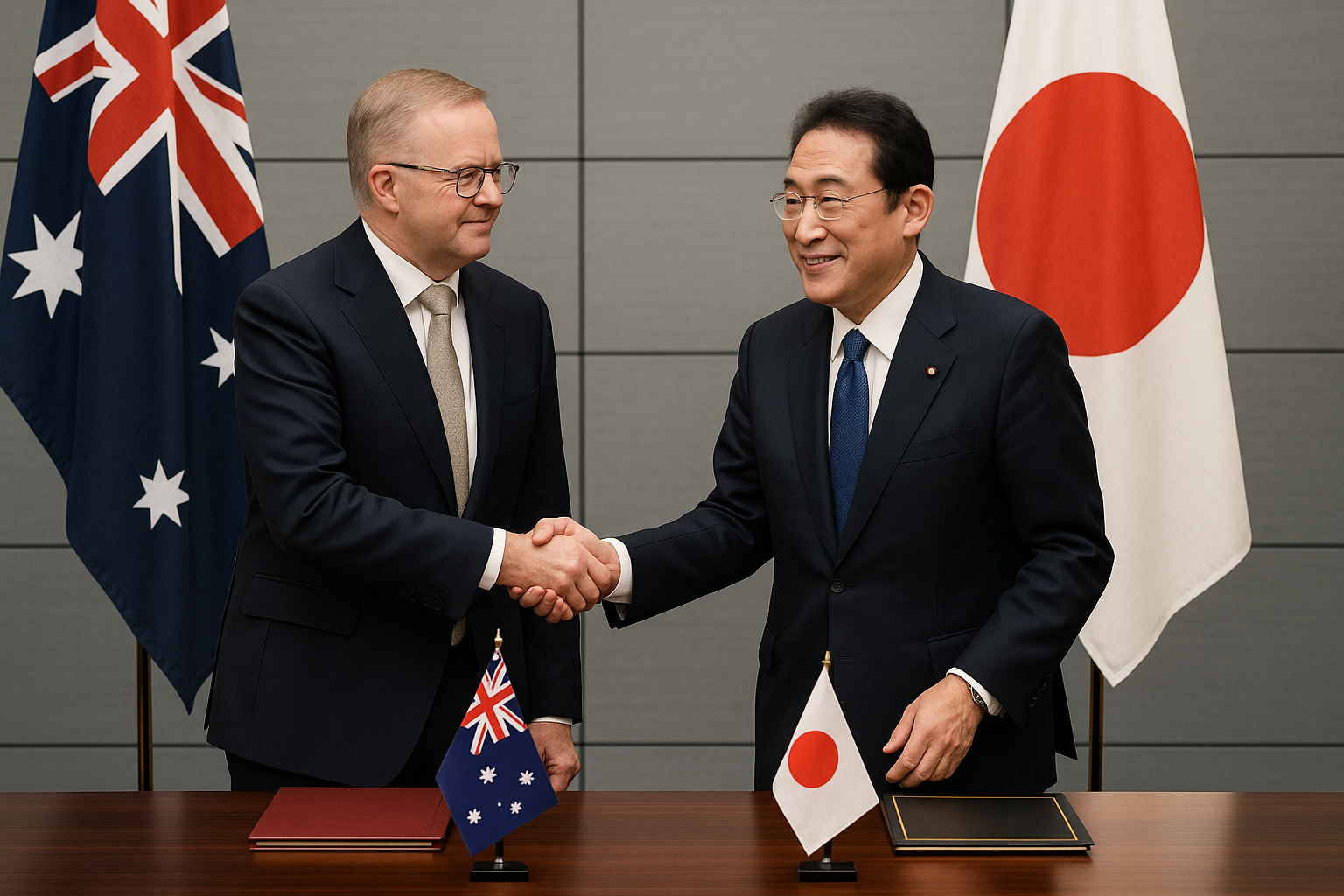
Australia and Japan have signed a series of agreements to deepen cooperation in energy, defence, and critical minerals, marking a significant step in their strategic partnership amid regional security and supply chain concerns.
Key Facts
- Australia and Japan signed multiple agreements covering energy, defence, and critical minerals.
- The deals aim to strengthen supply chain security and regional stability.
- Both nations highlighted the importance of reliable energy and mineral resources.
- Defence cooperation will include joint exercises and technology sharing.
- The agreements come amid rising geopolitical tensions in the Asia-Pacific.
- Japan is seeking to diversify its energy and mineral imports.
- Australia is a major supplier of critical minerals needed for advanced technologies.
- Leaders from both countries emphasized shared democratic values and mutual interests.
Overview
Australia and Japan have taken a major step to boost their strategic partnership by signing a series of agreements focused on energy, defence, and critical minerals. The new deals are designed to enhance cooperation between the two countries, ensuring more secure supply chains and greater regional stability.
The agreements were signed during a high-level meeting between Australian and Japanese leaders, reflecting growing concerns about energy security and the need for reliable sources of critical minerals. Both nations underscored their commitment to shared democratic values and the importance of working together in an increasingly complex Asia-Pacific region.
Defence collaboration will be expanded through joint military exercises and increased technology sharing. In the energy and minerals sectors, the agreements aim to diversify supply sources and reduce vulnerabilities to global disruptions. Japan, which relies heavily on imports for energy and minerals, sees Australia as a key partner for its economic and security needs.
These developments come as geopolitical tensions rise in the region, with both countries seeking to strengthen alliances and safeguard their interests. The agreements are expected to have long-term impacts on trade, security, and technological innovation for both Australia and Japan.
In Depth
The signing of these agreements marks a significant milestone in the Australia-Japan relationship, which has evolved rapidly in recent years. Both countries have recognized the need to adapt to shifting global dynamics, particularly in the wake of supply chain disruptions and heightened security challenges in the Asia-Pacific.
Energy security is a central focus of the new partnership. Japan, the world's third-largest economy, is highly dependent on energy imports, especially liquefied natural gas (LNG) and coal. Australia is one of Japan's primary suppliers of these resources. The new agreements are expected to facilitate further investment in renewable energy projects, hydrogen development, and the stable supply of fossil fuels during the transition to cleaner energy sources.
Critical minerals, such as lithium, cobalt, and rare earth elements, are essential for manufacturing batteries, electronics, and advanced defence systems. Australia possesses abundant reserves of these minerals, while Japan is seeking to reduce its reliance on a small number of overseas suppliers. The agreements include provisions for joint exploration, research, and development, as well as measures to ensure ethical and sustainable mining practices.
On the defence front, the two countries have pledged to deepen their security cooperation. This includes more frequent joint military exercises, intelligence sharing, and collaboration on emerging technologies such as cybersecurity and space. The move reflects a broader trend of increased defence ties among like-minded democracies in the region, as they respond to the evolving security environment.
The timing of the agreements is notable, as regional tensions have been heightened by events such as the closure of the Strait of Hormuz and ongoing disputes in the South China Sea. Japanese Prime Minister Fumio Kishida has highlighted the 'enormous impact' of energy disruptions on Asia, underscoring the urgency of securing alternative supply routes and partners.
Australian officials have emphasized that the agreements are not directed against any specific country, but are intended to promote stability and prosperity in the region. Both governments have reiterated their commitment to a free and open Indo-Pacific, based on the rule of law and respect for sovereignty.
Industry experts believe the deals will encourage further private sector collaboration and investment, particularly in the development of new energy technologies and the processing of critical minerals. The agreements are also expected to create new opportunities for research institutions and universities in both countries.
In summary, the Australia-Japan agreements represent a comprehensive approach to addressing shared challenges in energy, security, and economic resilience. As the global landscape continues to shift, the partnership between these two nations is likely to play an increasingly important role in shaping the future of the Asia-Pacific.
Commonly Asked Questions
What areas do the new Australia-Japan agreements cover?
The agreements cover energy cooperation, defence collaboration, and the supply and development of critical minerals.
Why are critical minerals important in the Australia-Japan partnership?
Critical minerals are essential for advanced technologies, including batteries and electronics. Australia is a major supplier, and Japan seeks to diversify its sources to ensure stable supply.
How will defence cooperation between Australia and Japan change?
Defence cooperation will expand to include more joint military exercises, technology sharing, and collaboration on emerging security challenges.
What prompted the timing of these agreements?
Rising geopolitical tensions and recent disruptions to global energy supplies, such as the closure of the Strait of Hormuz, have highlighted the need for stronger partnerships.
How do these agreements affect the broader Asia-Pacific region?
The agreements aim to enhance regional stability, secure supply chains, and promote a free and open Indo-Pacific, benefiting both countries and their partners.
Reliability Score
98/100
Sources
- EFE: Australia and Japan sign agreements on energy, defence and critical minerals – Australian Broadcasting Corporation
- TIME: Hormuz crisis impacts Asia, says Japan PM – Daily Times
- Anadolu Agency: Closure of Hormuz 'inflicting enormous impact' on Asia: Japanese premier – Anadolu Ajansı
- The Australian: After decades of pacifism, Japan arms its neighbours – The Australian
- Al Jazeera: Japan PM says Iran war oil crisis having ‘enormous impact’ in Asia Pacific – Al Jazeera
- Jakarta Post: Australia and Japan sign agreements on energy and critical minerals – The Jakarta Post
- The Straits Times: Australia and Japan sign agreements on energy and critical minerals – The Straits Times
- Reuters: Australia and Japan sign agreements on energy and critical minerals – Reuters