
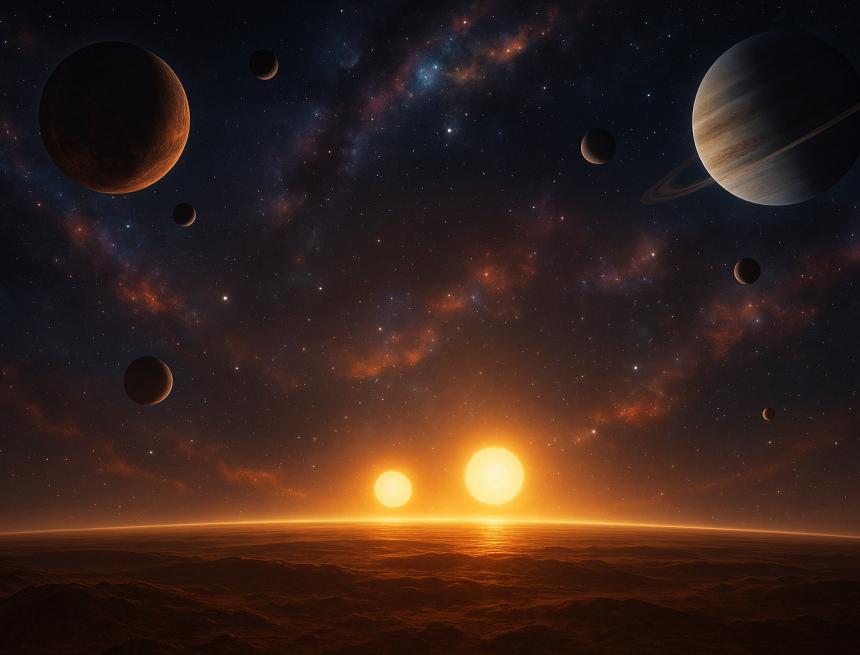
Astronomers have identified 27 planets orbiting a pair of stars, marking one of the largest multi-planet discoveries in a binary system. The finding offers new insights into how planets form and survive in complex star systems.
Key Facts
- Astronomers have discovered 27 planets orbiting two stars in a binary system.
- The system is reminiscent of the fictional planet Tatooine from 'Star Wars', which also orbits two suns.
- This is one of the largest known collections of planets in a binary star system.
- The discovery was reported by multiple science news outlets in early May 2026.
- The planets were detected using advanced astronomical observation techniques.
- The finding challenges previous assumptions about planet formation in binary systems.
- Researchers believe some of these planets could have stable orbits despite the gravitational complexity.
- The discovery opens new avenues for studying planetary system evolution.
Overview
In a breakthrough for planetary science, astronomers have found 27 planets orbiting a pair of stars, creating a real-life version of the iconic 'Tatooine' system from science fiction. This discovery stands out as one of the largest groups of planets ever found in a binary star system, where two suns orbit each other.
The research, highlighted by several science news outlets, was announced in May 2026. Scientists used advanced telescopes and data analysis to detect the planets, which range in size and distance from their twin suns. The system's complexity offers a rare opportunity to study how planets can form and survive in environments previously thought to be too unstable.
Binary star systems are common in our galaxy, but finding so many planets in one such system is unusual. The gravitational forces from two stars make it difficult for planets to maintain stable orbits, yet this discovery shows that planetary systems can be more resilient than previously believed.
Experts say the finding could reshape our understanding of planet formation and the potential for life in diverse star systems. The discovery also fuels excitement about the possibility of more 'Tatooine-like' worlds waiting to be found.
In Depth
The identification of 27 planets orbiting a binary star system marks a significant advancement in exoplanetary research. Traditionally, the presence of two stars was thought to create a chaotic environment, making it unlikely for multiple planets to form and persist. The gravitational interplay between the stars can disrupt the protoplanetary disk, the region of dust and gas where planets are born, leading to unstable orbits or even ejection from the system.
However, the newly discovered system challenges these assumptions. Using a combination of transit observations and radial velocity measurements, astronomers were able to confirm the presence of these planets. The planets vary in size, with some potentially being rocky like Earth and others more similar to gas giants. Their orbits also differ, with some circling close to the twin stars and others much farther out.
The discovery was made possible by improvements in telescope sensitivity and data analysis algorithms. By monitoring the light from the binary stars, researchers detected subtle dips in brightness caused by planets passing in front of the stars. These transit events, combined with measurements of the stars’ motion, allowed scientists to estimate the planets’ masses and orbital characteristics.
One of the most intriguing aspects of this system is the apparent stability of many of the planets’ orbits. Despite the gravitational tug-of-war between the two stars, several planets maintain regular, predictable paths. This suggests that planet formation in binary systems may be more robust than previously thought, and that such systems could host a wide variety of planetary environments.
The discovery has broader implications for the search for life beyond our solar system. Binary star systems are common in the Milky Way, and if they can host large numbers of planets, the number of potentially habitable worlds could be much higher than earlier estimates. Future observations, including spectroscopic analysis of planetary atmospheres, may reveal whether any of these worlds have conditions suitable for life.
Researchers are now planning follow-up studies to learn more about the composition and atmospheres of these planets. The findings also encourage astronomers to re-examine other binary systems for hidden planets, using the latest observational techniques. As technology advances, the catalog of known exoplanets in complex star systems is expected to grow, offering new insights into the diversity and resilience of planetary systems across the galaxy.
Commonly Asked Questions
How were the 27 planets detected in the binary star system?
Astronomers used advanced telescopes and data analysis methods, including transit observations and radial velocity measurements, to detect the planets orbiting the two stars.
Why is this discovery significant?
It is one of the largest known collections of planets in a binary system, challenging previous beliefs about the difficulty of planet formation in such environments.
What makes this system similar to 'Tatooine' from Star Wars?
Like Tatooine, the planets in this system orbit two suns, creating a double-sunset effect and a complex gravitational environment.
Could any of these planets support life?
While detailed studies are ongoing, the discovery increases the possibility that binary systems could host habitable planets, but no evidence of life has been found yet.
What are the next steps for researchers?
Scientists plan to conduct follow-up observations to study the planets’ atmospheres and compositions, and to search for more planets in other binary systems.
Reliability Score
57/100
Sources
- Science: Science Just Made 'Star Wars' Canon as Astronomers Discover 27 Real-Life Tatooine-Like Planets – Comic Basics
- The Guardian: Rare comet to flash through New Zealand skies – before it disappears for 170,000 years – The Guardian
- EFE: Scientists Discover 27 Potential New Planets Orbiting Two Stars – streamlinefeed.co.ke