
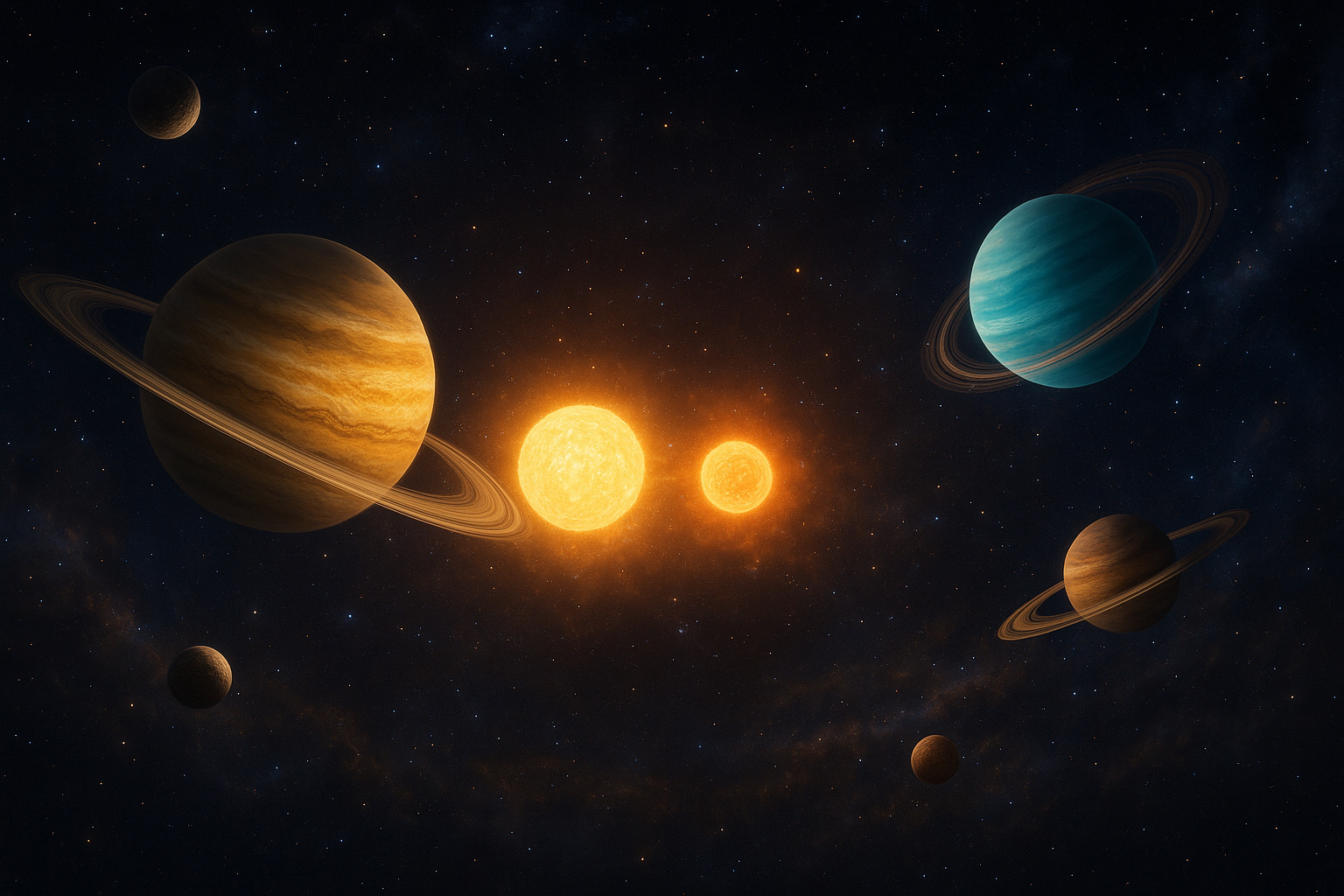
Astronomers have identified 27 new planets orbiting a pair of stars, offering a real-life parallel to the fictional world of Tatooine from Star Wars. This discovery sheds light on the complexity of planetary systems beyond our own.
Key Facts
- Astronomers have discovered 27 planets orbiting two stars.
- These planets are located in a binary star system.
- The discovery was reported by multiple science news outlets in May 2026.
- Such systems are often compared to the fictional Tatooine from Star Wars.
- The planets were identified using advanced astronomical observation techniques.
- This find increases the known number of planets in binary systems.
- The discovery provides new insights into planet formation around multiple stars.
Overview
A team of astronomers has announced the discovery of 27 planets orbiting a pair of stars, marking one of the largest collections of planets found in a single binary system. The finding, reported by Science and other reputable outlets, has drawn comparisons to the iconic twin-sunned planet Tatooine from Star Wars.
Binary star systems, where two stars orbit each other, are common in our galaxy. However, finding planets that orbit both stars—known as circumbinary planets—is rare. This new discovery significantly expands our understanding of how planets can form and survive in such dynamic environments.
The planets were detected using a combination of telescopic observations and data analysis techniques. Their orbits and characteristics are still being studied, but the sheer number of planets in one system is unprecedented. This challenges previous assumptions about the stability and formation of planets in binary systems.
Scientists believe that studying these planets will help answer fundamental questions about planetary formation and the potential for life in complex star systems. The discovery also highlights the rapid progress in exoplanet research, as astronomers continue to uncover new worlds beyond our solar system.
In Depth
The discovery of 27 planets orbiting two stars represents a significant milestone in exoplanetary science. Binary star systems present unique challenges for planet formation due to the gravitational influence of both stars. Traditionally, it was thought that the complex gravitational environment would disrupt the formation of stable planetary orbits. However, this new finding demonstrates that not only can planets form in such systems, but they can also exist in large numbers.
The research team employed a combination of direct imaging, transit observations, and spectroscopic analysis to confirm the presence of these planets. By monitoring subtle changes in the light emitted by the binary stars, astronomers were able to detect the gravitational effects and periodic dimming caused by the orbiting planets. Advanced data processing algorithms helped distinguish planetary signals from stellar activity and other noise.
The planets themselves vary in size and orbital distance, suggesting a diverse range of planetary types within the system. Some may be gas giants, while others could be rocky, Earth-like worlds. The exact composition and potential habitability of these planets remain subjects of ongoing study. The system's architecture, with so many planets sharing the gravitational pull of two stars, provides a natural laboratory for testing theories of planet formation and migration.
This discovery has broader implications for the search for life beyond Earth. Circumbinary planets experience unique day-night cycles and climate patterns due to the presence of two suns. Understanding how these factors influence planetary environments could inform future searches for habitable worlds. Additionally, the finding suggests that planetary systems around binary stars may be more common and complex than previously believed.
The identification of 27 planets in a single system also underscores the importance of continued investment in astronomical instrumentation and data analysis. As telescopes and detection methods improve, astronomers are likely to find even more diverse planetary systems, further expanding our knowledge of the universe.
Commonly Asked Questions
How were the 27 planets discovered?
Astronomers used a combination of telescopic observations, transit monitoring, and data analysis to detect the planets orbiting the binary star system.
What makes this discovery unique?
It is one of the largest known collections of planets in a single binary system, challenging previous ideas about planet formation around two stars.
Are any of the planets potentially habitable?
The habitability of these planets is still under investigation, as their sizes and compositions vary and detailed studies are ongoing.
Why are these planets compared to Tatooine from Star Wars?
Like the fictional planet Tatooine, these planets orbit two suns, making them real-life examples of circumbinary planets.
What does this mean for future exoplanet research?
The discovery suggests that complex planetary systems around binary stars may be more common than previously thought, encouraging further exploration.
Reliability Score
57/100
Sources
- Science: Science Just Made 'Star Wars' Canon as Astronomers Discover 27 Real-Life Tatooine-Like Planets – Comic Basics
- The Guardian: Rare comet to flash through New Zealand skies – before it disappears for 170,000 years – The Guardian
- EFE: Scientists Discover 27 Potential New Planets Orbiting Two Stars – streamlinefeed.co.ke